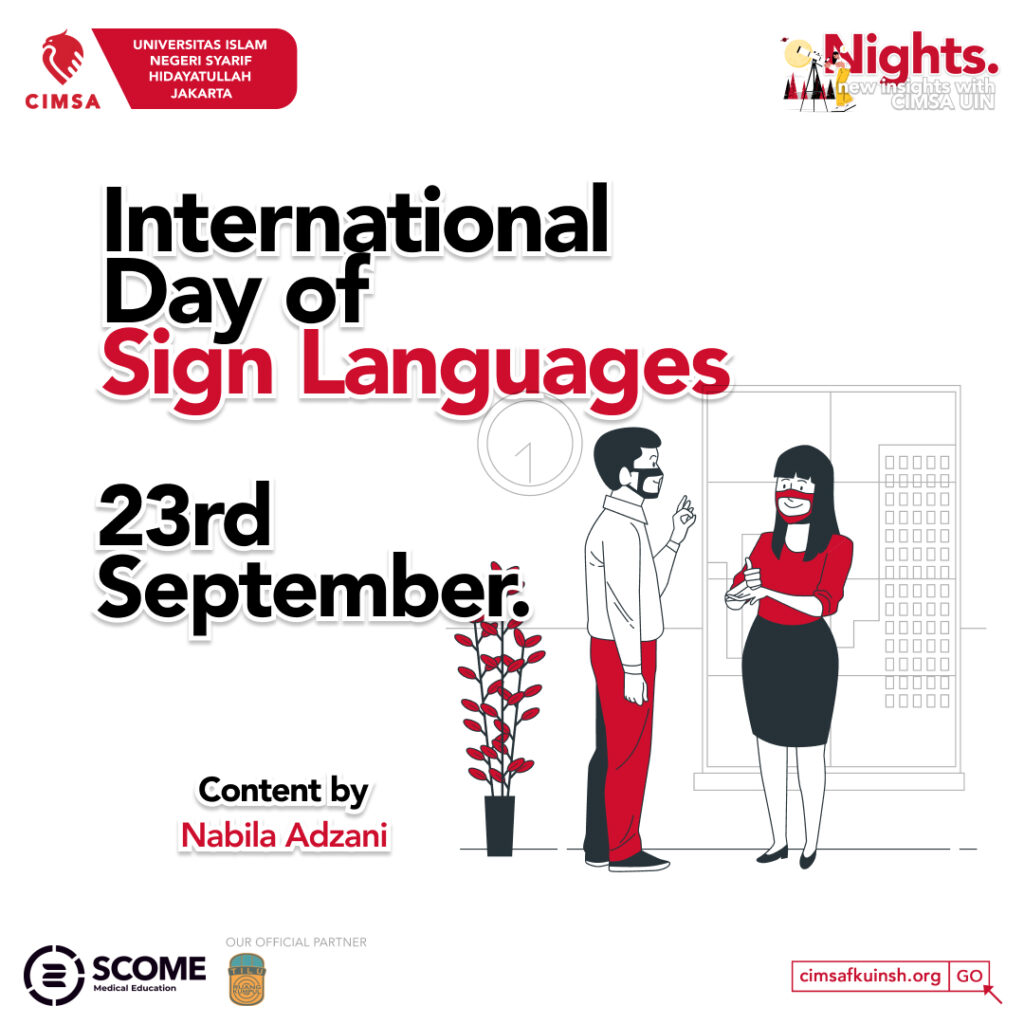
On September 23, 1951, the World Federation of the Deaf (WFD) was founded, marking the birth of a vital organization dedicated to advocating for the rights of the deaf community. One of its main objectives is to preserve and promote sign language and deaf culture as fundamental human rights.
What is Sign Language?
Sign language is a fully developed, natural language that relies on visual gestures, expressions, and symbols instead of spoken words. It has its own grammar, syntax, and vocabulary, distinct from any spoken language. According to the Kamus Besar Bahasa Indonesia (KBBI), sign language is defined as a system of communication that uses symbols, independent of written or spoken language. This makes sign language an essential tool for communication, particularly for individuals who are deaf or hard of hearing.
Why Medical Students and Doctors Should Learn Sign Language
- Building Connections with Deaf Colleagues and PatientsFor medical students and doctors, learning sign language is more than a skill—it’s a way to foster deeper, more meaningful relationships with their deaf colleagues and patients. Understanding sign language allows healthcare professionals to engage in conversations that go beyond the surface level, helping build trust and a sense of belonging within the medical community. This connection isn’t just about clinical care; it’s about creating an inclusive environment where everyone feels respected and supported.
- Preventing Discrimination Against Deaf PatientsCommunication barriers can lead to significant disparities in healthcare. Deaf patients who rely on sign language often face challenges when healthcare providers are unable to communicate with them effectively. This can result in misunderstandings, delayed diagnoses, and inadequate care. By learning sign language, medical professionals can bridge these gaps and ensure that every patient receives the quality care they deserve, without any form of discrimination based on their ability to hear or speak.
- Understanding the Unique Challenges Deaf Patients FaceDeaf patients often encounter hurdles in accessing healthcare due to communication barriers. These challenges may include delayed medical attention, misinterpreted symptoms, and difficulties in follow-up care. By becoming proficient in sign language, medical professionals gain a better understanding of these challenges, enabling them to provide more compassionate and effective care. This level of understanding helps doctors tailor their treatments to the specific needs of deaf patients, improving overall health outcomes.
- Recognizing Healthcare as a Fundamental Right for AllAccess to healthcare is a universal right, and sign language education plays a crucial role in ensuring that this right is upheld for everyone, including individuals who are deaf or hard of hearing. Medical professionals who learn sign language are better equipped to provide accessible, equitable care. In many countries, including the United States under the Americans with Disabilities Act (ADA), healthcare providers are legally required to offer reasonable accommodations, such as interpreters, to ensure that patients with disabilities receive proper care. Learning sign language is a step toward fulfilling this responsibility and upholding the principle that healthcare is for everyone, regardless of their communication needs.
A Call to Action for Inclusive Medical Training
By integrating sign language education into medical training, we take a step closer to a more inclusive and equitable healthcare system. It’s not just about learning a language—it’s about ensuring that every patient, regardless of their ability to speak or hear, is treated with dignity and respect. In a field where communication is often the cornerstone of care, learning to communicate with all patients, including those who use sign language, is a powerful way to uphold the values of compassion, inclusivity, and fairness in healthcare.
Let’s move toward a future where no patient is left behind, and where sign language is as much a part of medical training as any other vital skill.
Content by – Nabila Adzani
REFERENCE
- Internation Days [Internet]. INTERNATIONAL DAYS. 2014 [cited 2024 Sep 22]. Available from: https://www.internationaldays.org/september/international-day-of-sign-languages
- Setiawan E. Arti Kata Isyarat Kamus Besar Bahasa Indonesia (KBBI) Online [Internet]. 2023 [cited 2024 Sep 22]. Available from: https://www.google.com/amp/s/kbbi.web.id/isyarat.html